
Eating Out on Holiday: Is It Still Part of the Travel Experience?

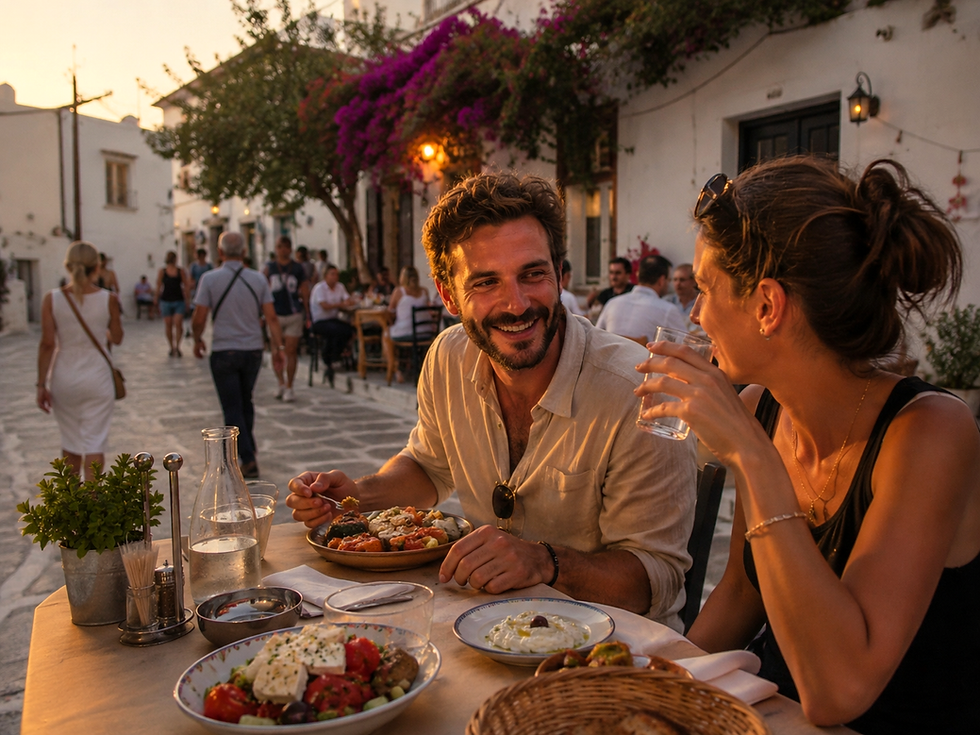
For many people, holidays used to come with an unwritten rule:
You travelled somewhere new, and eating out was simply part of the experience.
Breakfast at a café. Lunch near the beach. Dinner at a taverna, restaurant or small local food spot.
Today, things are more complicated.
Accommodation with a kitchen is easier to find. Supermarkets offer almost everything a traveller might need. Families are planning their holiday spending more carefully, and many visitors now combine eating out with meals prepared at their apartment, room or holiday home.
There is nothing strange about that.
In fact, it makes perfect sense.
But it also raises an interesting question:
When we cook most of our meals while travelling, do we save only money — or do we sometimes leave part of the travel experience behind?
The holiday budget has changed
Cost matters.
That is probably the most important starting point for any honest discussion about eating out today.
In Greece, official inflation data continue to show pressure both on food purchased for the home and on restaurants and accommodation. In April 2026, the Consumer Price Index for food and non-alcoholic beverages was 4.4% higher than a year earlier, while restaurants and accommodation services were 6.1% higher.
For a couple, this may mean making a few more careful choices.
For a family of four, the difference can be significant. Breakfast, lunch, drinks, snacks and dinner outside every day can quickly become one of the largest parts of a holiday budget.
So buying fruit, water, breakfast ingredients, sandwiches or a few simple meals from a supermarket is not a rejection of local restaurants. It is often simply budgeting. And there is nothing wrong with that.
The supermarket gives travellers control
Cooking during a holiday offers several real advantages. The first is obvious: control over spending.
A supermarket allows travellers to decide exactly what they want to spend and how many meals they can create from one shopping trip.
There are other advantages too. Families with young children may find it easier to prepare something familiar. Travellers with allergies or specific dietary needs may feel safer knowing exactly what is in their food. Someone staying for two weeks may simply not want restaurant meals twice a day.
And sometimes a simple breakfast on a balcony, with local bread, fruit and coffee, can be one of the nicest moments of the trip. Eating at home is not automatically less authentic.
It can even become part of experiencing a destination if the ingredients come from local bakeries, markets, grocers and producers.
But holidays are also about escaping routine
There is another side.
At home, many of us already:
shop for groceries,
prepare food,
set the table,
wash dishes,
clean the kitchen,
and decide what everyone is going to eat.
For some travellers, doing exactly the same thing every day on holiday can gradually turn the apartment into another version of home.
Cooking can be enjoyable. Cooking because everyone is hungry at 9:30 at night after a full day at the beach may be less enjoyable. Part of the traditional appeal of a holiday is allowing someone else to cook for you. You sit down.
You order something you would probably not prepare yourself. You talk. You look around.
And, for an hour or two, there is nothing to clean afterwards.
That also has value.
Food is one of the ways we understand a place
We often remember destinations through food.
A specific dish.
A tiny café.
A bakery discovered by accident.
A sandwich eaten while walking.
A family taverna that looked completely ordinary but produced one unforgettable meal.
Food carries information about a place in a way that very few other things can. Ingredients tell us what grows nearby. Recipes tell us something about history. Street food tells us how people actually eat.
Local restaurants show us flavours, habits and combinations that may never appear in a supermarket aisle. A traveller can see the architecture of a city, visit its museums and walk its streets. But eating its food adds another layer to the experience.
Eating out does not have to mean expensive dining
This is where the discussion often becomes unnecessarily extreme.
“Eating out” does not necessarily mean a long restaurant dinner with several courses and a large bill.
It can mean:
coffee and something from a local bakery,
a sandwich from an independent street-food shop,
a simple lunch,
a takeaway meal eaten by the sea,
a bowl from a small local kitchen,
one shared dish,
or dinner at a neighbourhood taverna away from the busiest tourist streets.
The choice is not always: supermarket or expensive restaurant.
There is a large space in between. And that middle ground may be the most realistic way to travel today.
A mixed approach may make more sense
Maybe modern holidays do not require choosing one side. A traveller can use the supermarket intelligently without turning every meal into home cooking.
For example:
Breakfast and fruit from the supermarket.
Water and snacks in the room.
A simple lunch prepared at the apartment.
Then dinner somewhere local.
Or perhaps dinner at home one evening and a takeaway meal from a small independent business the next.
The goal is not to spend for the sake of spending. It is to decide which meals are functional and which meals are part of the experience. That small distinction can completely change the way we think about the holiday food budget.
Not every restaurant experience is worth paying for
Restaurants also have responsibilities. Travellers do not owe businesses their money simply because they are on holiday. If a meal is overpriced, careless or designed only to take advantage of seasonal visitors, people have every right to choose differently.
A restaurant or food business must offer something that makes eating out worthwhile:
quality,
hospitality,
consistency,
convenience,
atmosphere,
local character,
or simply something that would be difficult to reproduce at home.
The growth of supermarket cooking can therefore also be viewed as useful pressure on the hospitality industry. Businesses must give customers a reason to come through the door.
Not through guilt. Through value.
Value is not the same as the lowest price
Price and value are related, but they are not identical.
A supermarket meal can be excellent value because it feeds several people affordably.
A €10 or €12 meal from a local food business can also offer value if it saves time, uses carefully prepared ingredients and gives the traveller an experience they could not easily create in their apartment.
And an expensive restaurant can offer poor value if the quality, service or experience does not justify the price.
The question is therefore not simply:
“Which option is cheaper?”
A better question might be:
“What am I getting in return for what I spend?”
Small food businesses are part of the places we visit
There is another dimension that is easy to overlook. The cafés, bakeries, tavernas, sandwich shops and small restaurants we encounter on holiday are not separate from the destination.
They help create it. They employ local people. They buy ingredients and services.
They occupy streets that might otherwise become identical from one city to another.
When travellers choose a local independent business, part of their holiday spending circulates through the local economy. Tourism remains enormously important to Greece. Travel receipts reached €23.63 billion in 2025, up 9.4% from the year before, according to the Bank of Greece.
That does not mean every visitor has a responsibility to spend beyond their means.
It simply means that where we spend is also part of how tourism shapes a place.
The danger of turning food into only a calculation
Budgeting is sensible.
But holidays can become strangely joyless if every decision is reduced to price per portion.
Sometimes the cheapest option is exactly what we need. Sometimes it is worth paying a little more because the experience itself matters. A traveller may not remember the €8 saved by cooking pasta in the apartment on Tuesday night. They might remember the tiny restaurant they found down a side street for years.
That does not make the restaurant meal financially “better”.
It makes it emotionally different. And travel has always contained both kinds of value.
There is also pleasure in buying local ingredients
The supermarket itself does not need to be the villain in this story.
Far from it. Visiting a local grocery store or market can be fascinating. Products are different from home.
Labels are unfamiliar. Local cheeses, cured meats, vegetables, bread, olive oil and regional products can become part of the discovery.
A holiday kitchen can therefore be used creatively.
Instead of recreating exactly the same meals we eat at home, we can use local ingredients.
Then eating in becomes another expression of the destination rather than an escape from it. The most interesting holiday food experience may include both: cooking with local products and eating food prepared by local people.
Convenience also has a value
There is one thing that is often forgotten in comparisons between supermarket food and restaurants:
time.
Shopping takes time.
Cooking takes time.
Cleaning takes time.
On a long holiday, that may not matter.
On a three-day city break, it might matter a great deal.
If someone has only a few hours to explore Ioannina, spending part of the afternoon shopping and cooking may save money but reduce the time available to actually experience the city.
A quick local takeaway meal or street-food stop may sometimes offer the best compromise: less time, controlled spending and a taste of the destination.
What independent food businesses need to understand
Changing travel habits are not something restaurants should complain about.
They are something restaurants need to understand.
People are more conscious of value.
They compare options.
They read menus before arriving.
They look at photographs and reviews.
They may decide that one restaurant meal is worth sacrificing two others for.
That means independent food businesses need to be clearer about what they offer.
Why is this sandwich different?
Why is this meat prepared here?
Why is this sauce worth tasting?
Why should someone choose this bowl instead of preparing something simple themselves?
The answer cannot simply be:
“Because we are a restaurant.”
The answer has to be in the food.

What we believe at Chubbies
At Chubbies, we do not believe everyone should eat out for every meal.
That would not be realistic. And it would not be necessary.
We believe that when someone chooses to spend money on food outside the home, the meal should justify that decision. It should have thought behind it.
It should use preparations that take time. It should have a clear identity.
And ideally, it should give the customer something different from what they could easily assemble themselves. That philosophy is one of the reasons we prepare our own meat recipes, work carefully on our bread, sauces and sandwich structure, and think about how each product comes together.
Not because home cooking is the enemy. Because eating out should offer something worth leaving the kitchen for.
Maybe the answer is not supermarket versus restaurant
The supermarket and the restaurant do not need to compete for every meal.
They serve different purposes. One gives control, flexibility and economy.
The other can offer discovery, hospitality, convenience and a connection to the food culture of a destination. Modern travel may simply require a more thoughtful balance between the two.
Buy breakfast. Cook something simple. Make a picnic. Try local ingredients.
But perhaps also leave space in the holiday for a meal you did not prepare yourself.
A small restaurant.
A neighbourhood taverna.
A bakery.
A street-food shop.
Something made by people who live and work in the place you came to visit.
Because sometimes food is not only something we need during a journey.
Sometimes it is part of the reason we remember the journey at all.


Comments