
How to Build a Balanced Sandwich: Flavour, Texture and Structure


A great sandwich is more than a collection of good ingredients.
Excellent bread, carefully prepared meat, cheese, vegetables and sauces can all taste good separately. But when they are placed together without balance, the final sandwich may become too heavy, too dry, too wet or simply difficult to eat.
The real challenge is not adding more.
It is deciding what each ingredient contributes, how much of it is needed and where it should be placed.
A balanced sandwich should deliver flavour, texture and structure in every bite. The bread must support the filling. The meat should remain central without overpowering everything else. Sauces should connect the ingredients rather than hide them. Acidity, freshness and contrast should prevent richness from becoming tiring.
At Chubbies, this balance is at the centre of how every sandwich is designed.
More filling does not always mean a better sandwich
Large sandwiches can look impressive.
But size alone does not create quality.
When too much filling is placed between the bread, the sandwich becomes unstable. Ingredients move as soon as it is lifted, sauces escape from the sides and the customer may struggle to experience everything in one bite.
A successful sandwich needs the correct proportion between:
bread,
main filling,
cheese,
sauces,
vegetables,
and finishing ingredients.
The objective is not to make every ingredient equally noticeable. Some elements should lead, while others should support.
The main meat preparation may provide the identity of the sandwich. A sauce may bring moisture. A cheese may contribute richness and saltiness. A fresh or acidic ingredient may make the next bite feel lighter.
Each element needs a purpose.
Balance begins with the bread

Bread is the structure of the sandwich.
It determines how much filling the sandwich can hold, how moisture is absorbed and how comfortably the finished product can be eaten.
Good sandwich bread needs:
a soft but stable crumb,
enough strength to carry the ingredients,
a crisp crust after warming,
the right thickness,
and a flavour that supports the filling.
Bread that is too thick dominates the sandwich. Bread that is too thin may tear or collapse.
A soft interior helps absorb a controlled amount of sauce and meat juices. A lightly crisp crust adds contrast and helps the sandwich keep its shape.
At Chubbies, the square bread creates a wide and stable surface. This allows the ingredients to be distributed more evenly, reducing the chance of having an empty edge and an overloaded centre.
The bread is not simply placed around the filling.
It is part of the recipe.
The main filling needs a clear role
Every sandwich needs a centre of gravity.
In many cases, this is the meat preparation.
The main filling should provide enough flavour and texture to define the sandwich, but it should not make every other ingredient irrelevant.
A tender meat benefits from something crisp or fresh. A rich preparation may need acidity. A milder filling may need a stronger sauce or cheese to give it direction.
The cooking method also affects the rest of the design.
Slow-cooked meat behaves differently from crispy chicken, a patty or thinly sliced handmade meat. Each one releases a different amount of moisture, has a different texture and requires a different balance around it.
This is why the filling cannot be chosen separately from the bread and sauces.
The whole sandwich must be designed together.
Richness needs contrast
Many satisfying sandwich ingredients contain richness.
Meat, cheese, mayonnaise and creamy sauces can create depth and comfort. But when every element is rich, the sandwich may become tiring after only a few bites.
Contrast prevents that from happening.
Acidity can come from:
a gastrique,
pickled ingredients,
mustard,
tomato-based elements,
citrus,
or a carefully balanced sauce.
Freshness may come from leafy greens, herbs or vegetables.
A small amount of acidity can make a rich ingredient feel clearer and lighter. It also helps separate the flavours, so the customer can taste more than fat and salt.
The goal is not to make the sandwich sour.
It is to give the richness somewhere to go.
Sweetness should be controlled
Sweetness appears in more sandwiches than people realise.
It may come from caramelised ingredients, sauces, cooked vegetables or the natural flavour of the bread.
A small amount can round off saltiness, smoke or acidity. Too much can turn a savoury sandwich into something heavy and confusing.
Sweetness works best when it has a clear purpose.
It may soften the sharpness of mustard, balance a smoky cream or complement the deeper flavour of slow-cooked meat.
But it should remain part of the background unless the sandwich is deliberately designed around a sweet-and-savoury contrast.
Balance does not mean removing sweetness.
It means preventing it from taking control.
Salt is distributed across the whole sandwich
Salt does not come only from seasoning the meat.
Cheese, sauces, cured or prepared meats and other ingredients can all add saltiness.
This means every component must be considered as part of the same system.
A meat preparation may taste properly seasoned on its own but become too salty once cheese and sauce are added. A mild ingredient may need more seasoning because the surrounding elements are neutral.
The final decision should always be made after tasting the complete sandwich.
Individual ingredients can be excellent separately and still create an unbalanced result together.
The customer eats the finished combination, not the components one at a time.
Texture keeps every bite interesting
Flavour is only part of the experience.
Texture determines how the sandwich feels from the first bite to the last.
A sandwich in which every ingredient is soft may feel flat, even when the flavours are good. A sandwich with too many hard or crispy elements may become difficult to eat.
The most satisfying combinations usually include contrast:
crisp crust and soft crumb,
tender meat and fresh leaves,
creamy sauce and a firmer vegetable,
melted cheese and a lightly toasted surface.
Texture should not be added just to create noise.
Every contrast must still fit the identity of the sandwich.
A crispy ingredient can provide energy, but it should not destroy the structure or make the sandwich too tall. A creamy sauce can bring comfort, but it should not remove all definition from the remaining ingredients.
Sauces should connect, not cover
Sauce is one of the easiest ways to damage an otherwise good sandwich.
Too little sauce leaves the bread and filling disconnected. Too much hides the flavour of the meat, softens the bread and escapes during eating.
The right amount of sauce should:
add moisture,
carry flavour across the sandwich,
connect the bread with the filling,
and support the main ingredients.
Different sauces may serve different roles.
One may provide creaminess. Another may add acidity, smoke or sweetness. When more than one sauce is used, they should not compete for attention.
The placement also matters.
A sauce applied directly against the bread behaves differently from one placed between meat and cheese. Some ingredients can act as a barrier, while others encourage moisture to move into the crumb.
The question is not simply, “How much sauce?”
It is also, “Which sauce goes where?”
Ingredient order changes the sandwich
Two sandwiches can contain exactly the same ingredients and still feel different because of the order in which they are assembled.
The layers influence:
moisture distribution,
stability,
temperature,
flavour perception,
and how the sandwich compresses during the bite.
A wet ingredient placed directly on the bread can soften it quickly. A heavy filling placed above delicate leaves may press them flat. Cheese positioned near a warm component behaves differently from cheese placed against a cooler sauce.
The first ingredient that reaches the tongue may also shape how the whole bite is perceived.
Assembly is therefore not a decorative step.
It is part of the recipe.
Height must remain practical
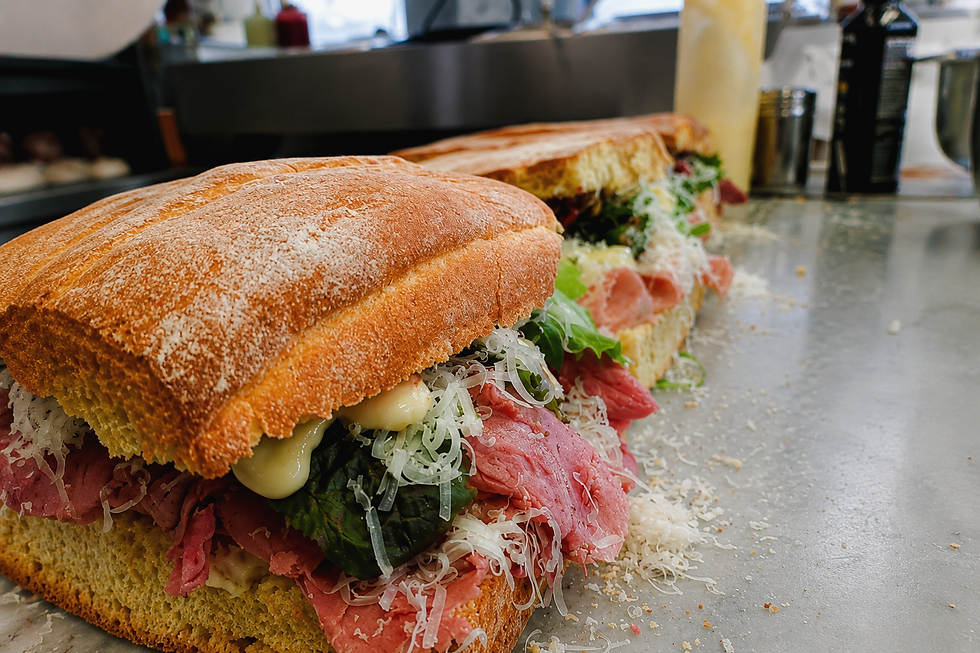
A tall sandwich may photograph well, but it still needs to be eaten.
When the height becomes excessive, the customer cannot take a complete bite. The top and bottom separate, the filling moves and the intended balance disappears.
A well-designed sandwich should compress naturally when held.
The bread should give slightly, the filling should remain in place and the customer should be able to experience several layers together.
This does not mean every sandwich must be small.
It means the height must match the structure of the bread and the texture of the filling.
A good sandwich should look generous without becoming a construction problem.
Every bite should contain the idea of the sandwich
The first bite often begins at an edge.
If the ingredients are concentrated only in the centre, the customer may taste mostly bread at the beginning and too much filling later.
Even distribution helps every bite contain the identity of the sandwich.
This requires attention to:
the placement of the meat,
the spread of sauces,
the distribution of cheese,
and the position of fresh ingredients.
Perfect mathematical uniformity is not necessary.
But the customer should not need to search for the main filling or reach the centre before understanding the sandwich.
The idea should be clear from the beginning.
Temperature affects flavour and structure
Temperature changes how ingredients behave.
Warm meat releases more aroma and may release additional moisture. Cheese softens. Sauces become looser. Bread can become crisp during warming but may begin to soften after assembly.
A balanced sandwich must account for these changes.
The ingredients should not simply be prepared correctly in isolation. They need to reach the correct temperature at the right time.
If a hot component sits too long before assembly, it may dry out. If the sandwich is wrapped immediately while releasing too much steam, the crust can soften quickly.
Temperature management is part of structure.
It affects not only whether the sandwich feels hot, but whether it remains enjoyable.
The Carbonato as an example of balance
The Carbonato shows how ingredients with strong character can work together without becoming chaotic.
The slow-cooked pork provides the main body of the sandwich. Smoked cream adds depth, while graviera brings richness and saltiness. Mushroom gastrique introduces acidity and complexity, and light mayonnaise supports moisture and smoothness.
Each element has a clear role.
The pork needs enough flavour to remain central. The smoked cream cannot become so dominant that everything tastes only of smoke. The graviera must contribute richness without making the sandwich excessively salty. The gastrique needs enough acidity to balance the fat, but not so much that it overwhelms the meat.
The bread holds these ingredients together, while its crisp crust provides contrast against the tender pork and creamy elements.
The balance does not come from making any ingredient weak.
It comes from giving every ingredient the right amount of space.
A lighter sandwich still needs structure
Balance is not only important in rich sandwiches.
A lighter sandwich can also feel incomplete if it lacks contrast or enough flavour.
Reducing sauce, cheese or fat does not automatically create balance. It may simply create dryness.
A lighter combination still needs:
moisture,
seasoning,
texture,
freshness,
and a clear main ingredient.
The difference is that these elements may be delivered through herbs, vegetables, lighter sauces or a different preparation of the meat.
“Light” should describe the eating experience, not the absence of flavour.
Takeaway changes the balance
A sandwich does not stop changing once it leaves the kitchen.
During takeaway or delivery:
steam remains inside the wrapping,
sauces move gradually through the filling,
bread absorbs moisture,
crisp ingredients soften,
and temperature begins to fall.
This means a sandwich that is perfectly balanced at the counter may behave differently after several minutes of transport.
The structure must be designed for both situations.
Sauce quantities, bread warming, wrapping and assembly time all influence how the sandwich travels.
A delivery sandwich may soften slightly, but it should not lose its identity or become impossible to hold.
The best takeaway food is designed with the journey in mind.
Testing requires the complete sandwich
A new combination should never be judged only by tasting the ingredients separately.
It needs to be assembled, warmed, held, compressed and eaten as a complete product.
It should also be tested after several minutes, not only immediately after preparation.
Important questions include:
Does the bread remain stable?
Is the meat still the main flavour?
Is there enough moisture?
Does the acidity balance the richness?
Can the sandwich be eaten without falling apart?
Does the final bite feel as balanced as the first?
Does it still work after being wrapped?
A good idea becomes a reliable product only after it survives real conditions.
Simplicity often requires more thought
Balanced sandwiches do not always contain many ingredients.
Some of the strongest combinations are relatively simple.
But simplicity makes every decision more visible.
When there are only a few components, the bread, meat, cheese and sauce must each perform correctly. There is nowhere for weak texture or poor seasoning to hide.
A longer ingredient list does not automatically create sophistication.
Sometimes, removing one unnecessary ingredient allows the remaining flavours to become clearer.
The objective is not to prove how much can fit inside the bread.
It is to create one complete idea.
Balance is what makes a sandwich memorable
Customers may first notice the size, the meat or the sauce.
What makes them enjoy the entire sandwich, however, is usually balance.
The bread carries the filling without becoming heavy. The meat has character without overpowering the other ingredients. Richness is controlled by acidity and freshness. Sauces provide moisture without hiding the preparation. Contrasting textures keep each bite interesting.
Nothing feels accidental.
At Chubbies, a sandwich is not treated as a pile of ingredients placed between bread.
It is designed as one complete product.
Flavour, texture, temperature, proportion and structure must all work together.
That is how separate ingredients become a balanced sandwich.


Comments